NIGERIA'S PURSUIT OF SDGS 1-4: A CRITICAL APPRAISAL OF POLICY IMPLEMENTATION AND DEVELOPMENT OUTCOMES
Abstract
This paper evaluates Nigeria's progress on sustainable development goals (SDGs) 1 to 4: No Poverty, Zero Hunger, Good Health/well-being, and Quality Education, using the Sustainable Development Goals framework as its theoretical framework. The study draws on qualitative data from Multidimensional Poverty Index (MPI) (2022), Voluntary National Review (VNR), peer review journals and other available data to show that despite the adoption of the SDGs in 2015, Nigeria is facing huge challenges as 63% of Nigerians are multidimensional poor, 25.5% of Nigerians do not get enough nutrition, while 26.4% suffer from severe levels of food insecurity, maternal mortality stands at 512 per 100,000 live births; over 10 million children are out-of-school. These underscore the effects of poverty and poor governance in heightening systemic obstacles to development. The paper concludes that Nigeria is off the track in pursuit of the goals, hindered by systemic governance failures and socio-economic disparities, and that only a holistic, multidimensional approach can accelerate achievement of the 2030 Agenda. Recommendations for achieving this include expansion of social protection and rural finance, investment in climate-smart agriculture and SMEs, Improve healthcare, education and teacher training. Governance reforms aligned to Vision 2050, the integration of technology and artificial intelligence (AI) in key sectors, and prioritization of rural development to accelarate sustainable development. These will be key in further expediting the progress of Nigeria and other Low-Income Countries toward the 2030 Agenda.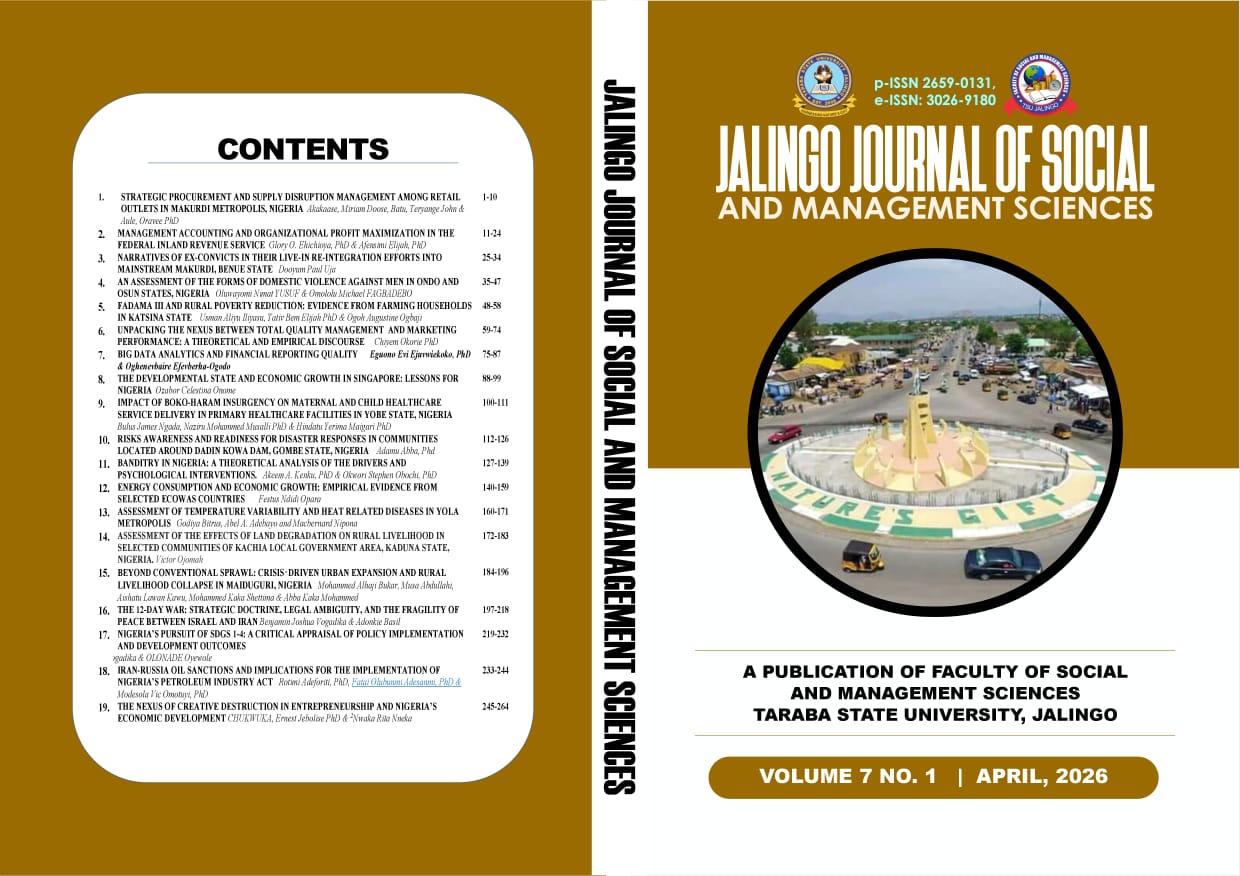
Downloads
Published
2026-04-07
Issue
Section
Articles
License
Copyright (c) 2026 JALINGO JOURNAL OF SOCIAL AND MANAGEMENT SCIENCES

This work is licensed under a Creative Commons Attribution-NonCommercial 4.0 International License.