Impact of Boko-Haram Insurgency on Maternal and Child Healthcare Service Delivery in Primary Healthcare Facilities in Yobe State, Nigeria
Abstract
This study assessed the impact of Boko Haram insurgency on maternal and child health service delivery using evidence from primary healthcare facilities in Yobe State. The study utilized relative deprivation theory to explain the activities of the insurgents on maternal and child health. Methodologically, the study adopted a mixed method of both qualitative and quantitative. The study adopted pragmatism philosophy which is based on naturalistic approach of data collection such as questionnaire and interviews. A total of 297 health personnel were administered with questionnaire across seven Local Government Areas under study and 21 interviews were conducted with health consumers, religious leaders and staff of primary healthcare board. Quantitative data was analyzed using descriptive and inferential statistics while the qualitative data was analyzed using thematic approach. The study reveals that Boko Haram insurgency has affected maternal and child health to the extent that most women give birth at home and maternal and child mortality have increased as a result of the destruction of primary healthcare centers, immunization programmes haves been cut-off due to the insurgents' activities. Also, the study reveals that malnutrition among children has increased because of lack of access to food. Thus, the study recommends that the Yobe State government, in collaboration with development partners such as World Health Organization and UNICEF should rebuild all affected primary healthcare centers in the affected Local Governments Areas so as to reactivate effective health service delivery.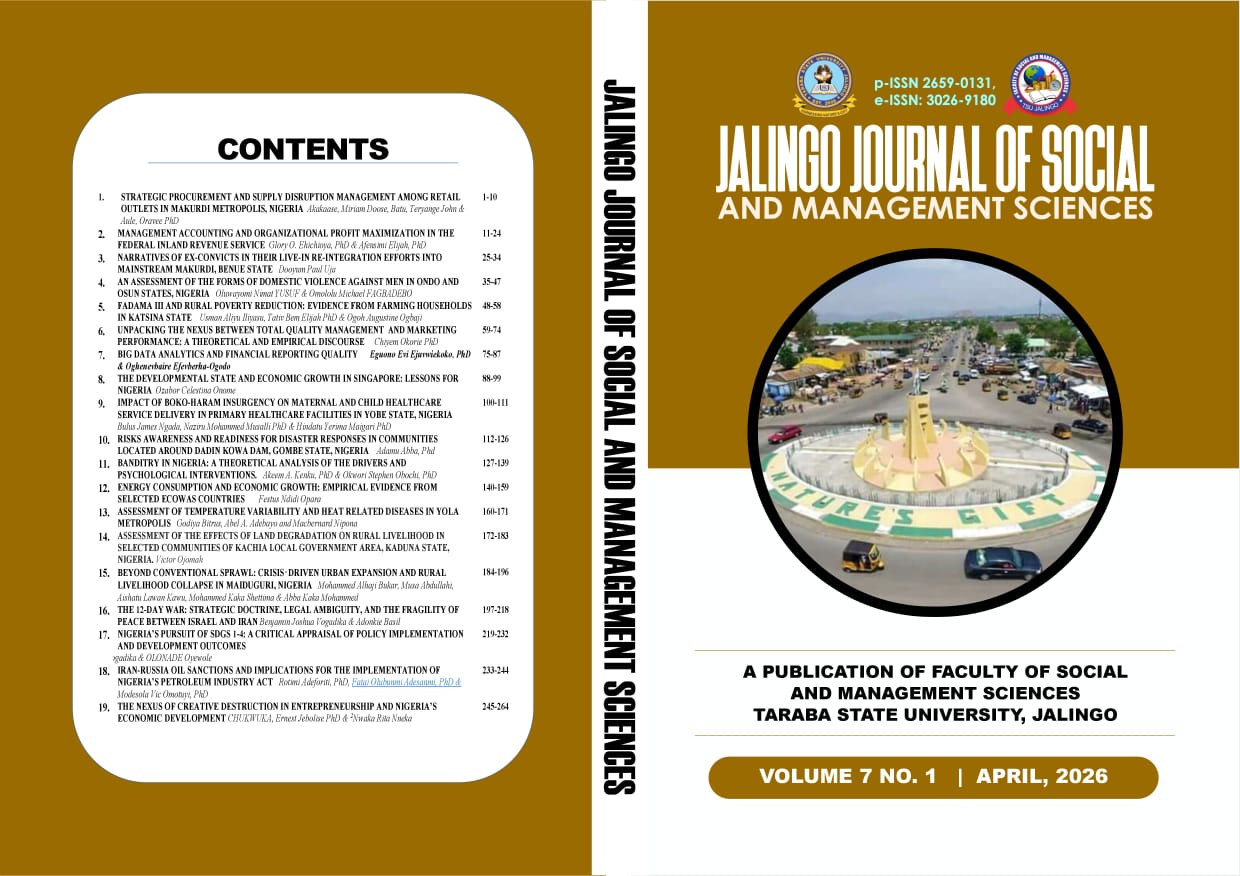
Downloads
Published
2026-04-07
Issue
Section
Articles
License
Copyright (c) 2026 JALINGO JOURNAL OF SOCIAL AND MANAGEMENT SCIENCES

This work is licensed under a Creative Commons Attribution-NonCommercial 4.0 International License.