The Developmental State and Economic Growth in Singapore: Lessons for Nigeria
Abstract
This study examines the concept of the developmental state and how it has been successfully applied in Singapore to achieve sustained economic growth. It analyses the strategic interventions made by the Singaporean government such as long-term planning, industrial policy, investment in human capital, and strong governance structures. More importantly, the paper evaluates the applicability of the Singapore model to Nigeria's economic developmental efforts. By identifying both the similarities and contextual differences between the two countries, the study highlights policy lessons that Nigeria can adopt to strengthen its economic foundations. The secondary data form the basis of the study which hinges on the developmental state theory as propounded by Johnson Chambers. The study concludes that while Nigeria cannot replicate Singapore's model in its entirety, adapting key principles such as institutional efficiency, targeted investment in infrastructure and education, and accountable leadership can facilitate inclusive economic growth. It thus recommends that public institutions should be strengthened, there should be reduction of dependence on oil by investing in other key sectors of the economy such as agriculture, manufacturing, tourism and the digital sector through supportive policies and incentives; and the modernization of transportation, energy and Information Communication Technology (ICT) to achieve sustainable growth.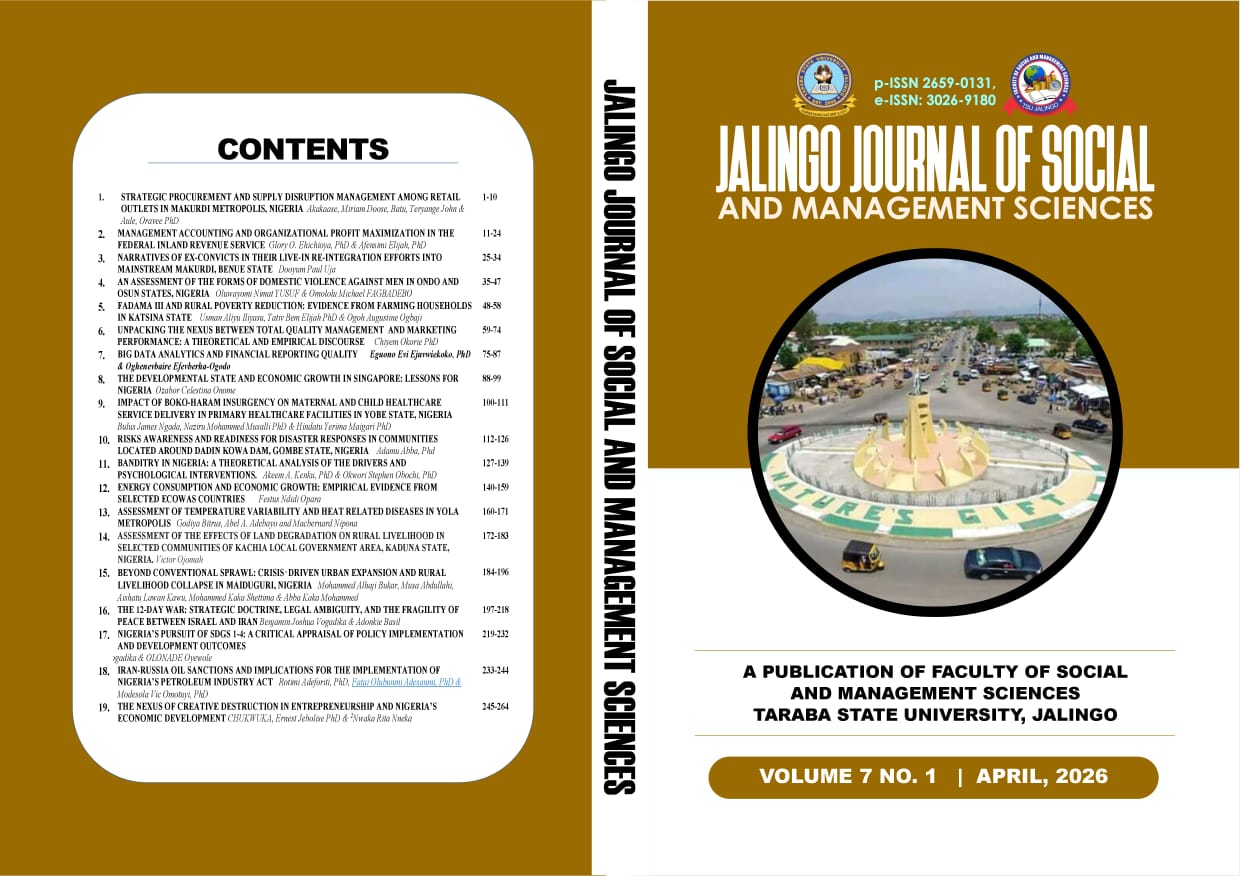
Downloads
Published
2026-04-07
Issue
Section
Articles
License
Copyright (c) 2026 JALINGO JOURNAL OF SOCIAL AND MANAGEMENT SCIENCES

This work is licensed under a Creative Commons Attribution-NonCommercial 4.0 International License.