Narratives of Ex-convicts in Their Live-in Re-integration Efforts into Mainstream Makurdi, Benue State
Abstract
Reintegrating back into society or community is what incarcerated persons who had committed crimes and are serving their terms or sentence in correctional centers or prisons look forward to. The gain of freedom at last, and the thought of experiencing the presence of family and loved ones bring joy and anxieties in the middle of their experiences and difficult moments. This study explored the life of nine ex-convicts through the narratives of their reintegration attempt into the community in Makurdi, Benue State. The study employed the phenomenological qualitative approach because the objective was to gain insight into the phenomenon of the narrative of reintegration into the community. By this, the thematic analysis method was utilized in organizing data collected and for analysis where two themes were evolved and narratives were anchored upon. These themes were: challenges of reentering the community, and breaking the vicious cycle by coping. The study, through the desistance and the reintegration theories, explained the impact of the individual ex-convict and the community on the reintegration phenomenon. The study showed that most ex-convicts experience challenges that could lead them to recidivating and, thus, they require strengths to cope with the challenges in order to live a crime-free life. Recidivism is seen as a global challenge just as incarceration itself, considering the crime situation. The study concluded that there are positive and negative aspects to reintegration. If ex-convicts are given a chance, they can be different and reintegrate, if not, they can only look at crime again and not reintegrate, if they work hard enough, given the available resources from the community, they can achieve a crime free lifestyle. The study recommended that government, trade and labour unions, and the private sector should give employment opportunities to ex-convicts who have employable skills in order to help them to fully reintegrate into the society and reduce recidivism.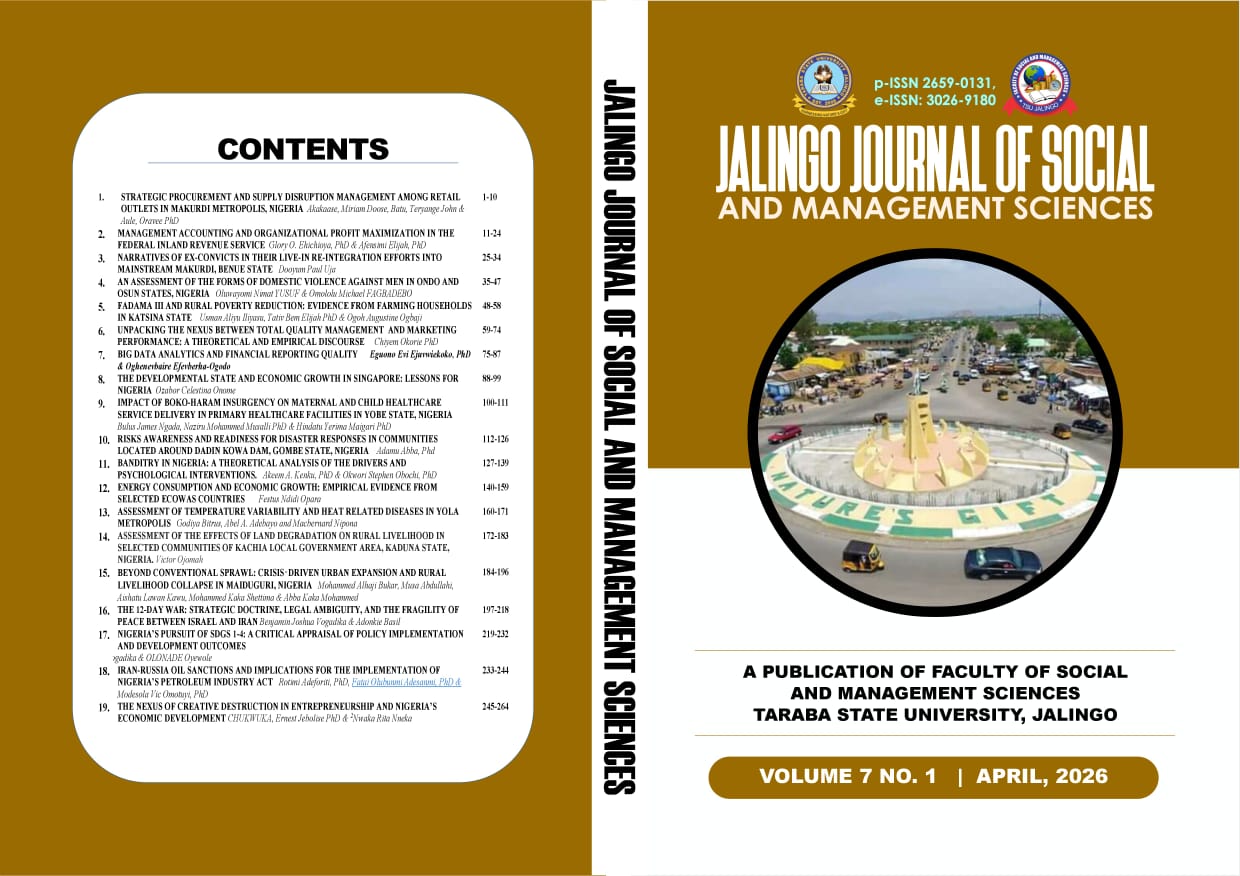
Downloads
Published
2026-04-07
Issue
Section
Articles
License
Copyright (c) 2026 JALINGO JOURNAL OF SOCIAL AND MANAGEMENT SCIENCES

This work is licensed under a Creative Commons Attribution-NonCommercial 4.0 International License.